
Why's everybody talking about vibe coding?
Beyond the Meme: The Tools That Are Actually Accelerating Software Teams

The vibe-coding meme
“Vibe-coding” is the word of 2025, according to Collins Dictionary
Vibe-coding is everywhere, you can now find it in every tech-related online community, Telegram, Discord, Slack, X, Reddit, etc. Usually with a negative connotation, to denote that an application is low-quality or improvised without clear vision.
Some of us even started using vibe- prefixed words in order to suggest that something is also low-quality, mediocre or improvised. (vibe-marketing, vibe-written, vibe-posting, vibe-leadership are just few examples that I’ve found looking my Telegram history)
In the last year in software development industry, we faced the faster and probably more important shift in our jobs (and many others). Vibe-coding, is just the most memetic part of what is really happening. A bigger anti-memetic picture of such revolution is worth to be spread too.
In this post, I will list some of the most interesting trends, that are fueled by vibe-coding, that I've been able to observe in the last 9 months.
The <Prompt/> component spread
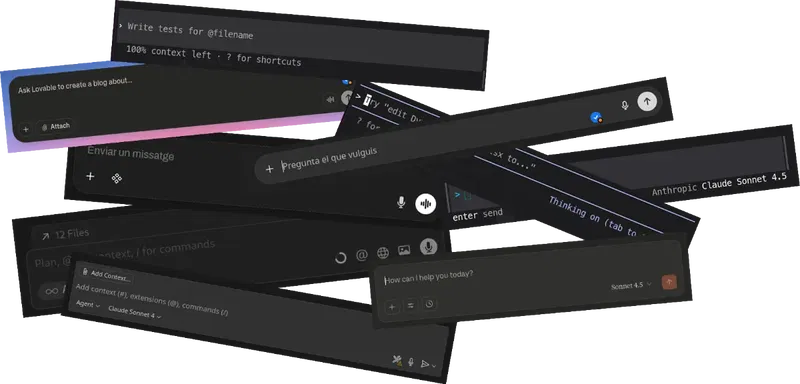
It’s 2025 and what your app needs is a prompt to interact with your stuff.
Starting from all major LLM model providers that have their own version of prompts. Followed by all traditional IDEs, or newly created ones with this specific purpose. One-by-one, all online products are adding a prompt to enhance (sometimes amazingly, many other times a little bit meh) your experience with the app. I’m sure others to pretend that is an AI company, or it did its homework to not be moved to the “legacy“. I gave https://slidetime.app a prompt — it worked, but the UX was… vibe-coding.
As users, we’re gradually getting more used to interact with <textarea /> to get a piece of information or ask for a task to be done.
And, as developers, it will be extremely hard to look back after this, and it is transforming how we work and the kind of applications we do.
New ways of working

Frankly, I haven’t seen this pace before in any other bubble. It’s really overwhelming. It didn’t happen one day by another though, each new toy related to usage of LLMs integrated in programming field started its own smaller revolution, on each iteration of each tool you can notice how the good ideas are copied between them.
You can check how recent are their increase on interest (they are super new apps, after all), the interest on using these tools isn’t stopped growing over time.
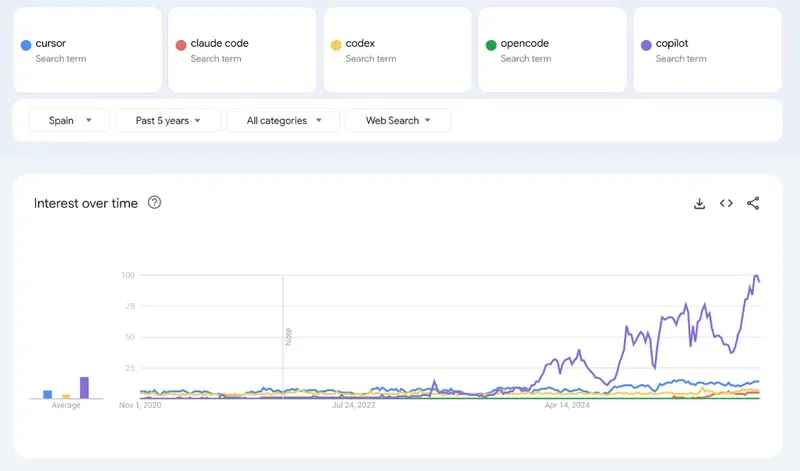
New open-source models and tools, proliferated at a huge pace. We’re optimizing our tools to work in a Factorio-mode, just because we figured out that the best Developer eXperience, happens to be also the best AI Agent eXperience.
Good documentation about the why’s, lessons learned, documenting changes, etc. is also useful for the AI Agents, so they can laser focus on how a project is maintained and replicate known patterns. Horizontally scaling applications is superfast now, you just need to create an architecture to allow fast adoption of features and ask new replicable features at will.
Refactoring is more needed than ever, you need to do checkpoints, stop adding features and accommodate code to be more scalable in the more frictionful parts.
Running several code agents in parallel
All agentic coder tools have their own version of parallel execution models. Just today, I updated Cursor to last version to see that they improved their support for agent execution in a project. But before that, all cloud agent services also provided an “ephemeral” coding agent execution.
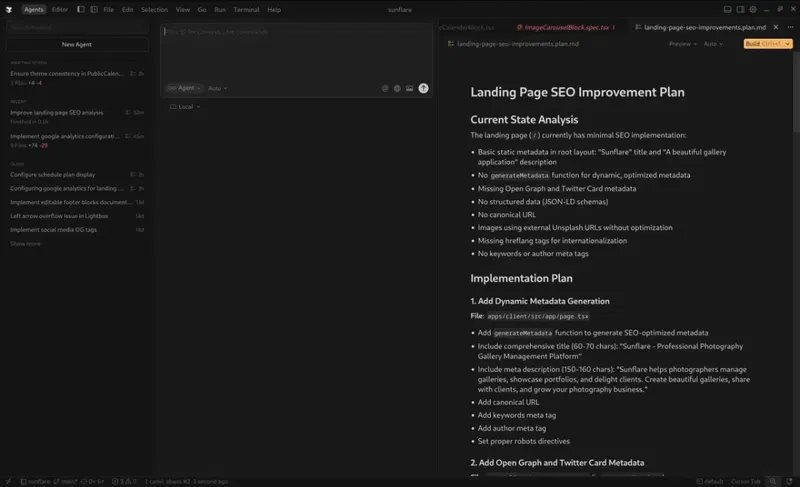
Some notable open-source projects exploring this approach are:
- https://openhands.dev
- https://opencode.ai
- https://github.com/BloopAI/vibe-kanban
- https://github.com/Ido-Levi/Hephaestus
Proliferation of repository file-based task managers
One of the major issues when you use LLMs to help you to code is how to properly manage the context, so the LLM has access to all the relevant information to perform the asked tasks without being overwhelmed.
In order to solve this issue, many new applications appeared to manage tasks to be executed by Code Agents. These tasks, usually contain all the context gathered in “planning“ mode so when you just ask for execution, you can start with the context empty and the agent won’t need to read half of your project to perform a good job. Here you can find some examples that help to accomplish this job.
Usually when you work with tasks like this you can ask for “I want to do X, because of y, look these files for examples on how to do it and create a task”, then you can just ask “implement task #23“ and see how the agent does the planned job.
Proliferation of new standards
Given that many Agent Coding tools are solving the same problems, it is normal that many new standards arise so you can share your project characteristics across tools. This is the case of AGENTS.md which allows you to give initial context to the LLMs to be more efficient working in your project. Or the quite recent Claude skills that are being translated to other CLIs and agentic coding tools with project like openskills.
The main goal of such standards, is removing vendor locking and being able to use available tools in an interchangeable way.
Proliferation of local and open sources models
This is just an adjacent trend that I think is pretty relevant, almost each month new open source (or better said open weights) models are released. So you can run them in your personal computer, smartphone or in a rented cloud instance. Unfortunately, if you want to use such models for agentic coding, you’ll need super expensive hardware or cloud instances at the moment.
Some examples of such open models are: Mistral, qwen3, glm and gpt-oss.
New prompt techniques to improve the coding experience
Many people tried to mimic a full engineering team, and others mapped all imaginable brainstorming methodologies and other skills as mere AI commands.
I even myself learnt a lot of “vibe“ skills on what things work well, what others don’t and some are meh. And this learning could only happen by practice.
https://blog.alexmaccaw.com/how-to-vibe-code-as-a-senior-engineer/
Trade-offs:
Almost everything is experimental and gets outdated fast. So take this into account before betting in a vendor-lock-in solution or mass adoption. Don’t put all the eggs in the same basked.
AI-related job titles getting really popular
A new lore, related to AI programming, emerged and suddenly started to be popularized over social networks. Prompt Engineering, AI Engineers. Such jobs are incredibly well paid. I believe we're yet to see many few jobs related to AI appearing.
Vive-coding is just a symptom
Sure! Making jokes about how bad vibe coding is, some blatant low quality apps that are appearing, and so many examples on how this proliferation and trend is happening is fun.
But don't miss the amount of rapid new toys that aren't stopping to improve and be more effective. These superpowers developers to be much more efficient developers each day. If you learn how to use these tools, you can go quite fast as compared to traditional old methods.
Be open-minded, have fun trying different things. I’ve never got so fun by creating software than now.
Links
https://omny.fm/shows/better-offline/vibe-coding-is-bs-w-charlie-meyer#description
https://knowyourmeme.com/memes/cultures/ai-artificial-intelligence
https://newsletter.pragmaticengineer.com/p/vibe-coding-as-a-software-engineer
https://nayafia.substack.com/p/introducing-antimemetics-my-new-book

Comments
No comments yet. Be the first to comment!